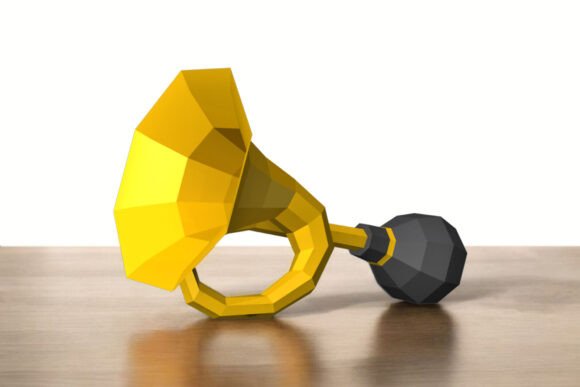
French Horn 3D Papercraft: An Embroidery Designer’s Review
As a professional embroidery designer and product reviewer, I approach every new asset with a critical eye toward stitchability and commercial viability. When I first examined the French Horn - 3d Papercraft files, my immediate focus was not on the paper assembly instructions, but on how this geometric structure could translate into a machine embroidery design. While the product is marketed as a papercraft template with PDF, DXF, EPS, PNG, and JPG formats, experienced makers know that these vector lines are goldmines for creating custom applique designs and structural embroidery art. The challenge—and the opportunity—lies in adapting a rigid 3D SVG concept into soft goods without losing the instrument's iconic character.
Translating Geometric Vectors to Stitched Reality
The first impression of the French Horn - 3d Papercraft digital files is one of clean, precise geometry. For an embroidery digitizer or a crafter using auto-digitizing software, these crisp lines are significantly easier to work with than hand-drawn sketches. However, a papercraft model relies on sharp folds and flat planes, whereas fabric has drape and texture. In my evaluation, I found that the shape naturally lends itself to a stylized, low-poly aesthetic rather than a photorealistic rendering. This is actually a benefit for small business owners and Etsy sellers; stylized instruments often perform better in commercial embroidery because they remain legible at smaller sizes and require less dense stitching, reducing production time and fabric puckering.
When considering this as a source for an embroidery file, the distinct segments of the papercraft horn suggest a segmented applique design. Instead of trying to fill stitch the entire shape, which can result in a bulletproof patch that ruins the drape of a garment, I recommend using the individual polygon shapes as guides for fabric pieces. This approach honors the "3D" nature of the original design while making it functional for textiles. The visual personality here is modern and architectural, making it ideal for boutique branding or music academy merchandise where a traditional, ornate clip-art look might feel dated.
Real-World Application: Custom Tote Bags and Apparel
To truly test the viability of French Horn - 3d Papercraft for real projects, I mentally prototyped a custom embroidered tote bag intended for a university music department fundraiser. Tote bags are a staple handmade product, but they present specific challenges due to canvas texture and weight. Using the vector lines from this set, I envisioned a two-tone applique where the darker brass tones are achieved through fabric choice rather than heavy thread coverage.
In this scenario, the assembled size reference of 18 x 18 x 32 CMS is crucial context. While you cannot embroider a 32cm object directly onto a standard tote without distortion, the proportions provided in the digital files allow for accurate scaling. For a sweatshirt embroidery project, specifically on heavyweight fleece, the geometric facets of this design work beautifully with running stitch outlines and minimal satin stitch borders. Customers react positively to this level of intentionality; it looks like a designed logo rather than a generic stock image. For baby embroidery or nursery decor, however, I would advise simplifying the internal facet lines. Too many seams or stitch lines can create rough textures against sensitive skin. In those cases, use the outer silhouette only, perhaps as a felt applique with a smooth finish.
Navigating Fabric Limitations and Hoop Constraints
Not every surface is suitable for a design derived from 3D papercraft geometry. Because this French Horn shape relies on straight lines and angles, it can look distorted if placed on highly stretchy fabrics without adequate stabilization. If you are planning custom apparel on performance wear or thin knits, you must use a high-quality cutaway stabilizer. The rigidity of the design vectors fights against the elasticity of the fabric, and without support, your registration marks will fail, leading to gaps between applique pieces.
Small hoop sizes also demand caution. The intricate faceting that makes the French Horn - 3d Papercraft visually interesting as a paper model becomes mud when shrunk below four inches. Tiny corners and acute angles are difficult for embroidery machines to execute cleanly. If your hoop size is limited, I strongly suggest editing the design to remove internal detail lines, focusing solely on the recognizable bell and tubing profile. Additionally, be wary of dark fabrics. Unless you are using light-colored applique fabric or high-contrast thread colors, the subtle dimensional cues of this design will disappear. Always test on scrap fabric first; what reads clearly as a vector on a screen may vanish on navy cotton.
Commercial Value and Professional Presentation
For creative entrepreneurs and digital product sellers, the value of this asset extends beyond the physical stitch-out. The inclusion of PNG and JPG formats allows for immediate creation of printable mockups. Before committing to sampling, I use these raster files to visualize placement on caps, aprons, and pillow covers. This saves time and materials. Furthermore, because the source includes DXF and EPS files, you have the flexibility to modify the design assets for different product tiers. A complex version for framed wall art and a simplified version for embroidered patches can both originate from this single purchase, maximizing ROI for your craft business.
Customer trust is built on consistency and quality. A finished product featuring this French Horn design should look intentional. If selling on Etsy or at craft fairs, ensure your listing photos show the texture of the embroidery. The "3D" aspect of the papercraft inspiration should be reflected in the dimensionality of your stitching—perhaps through layered fabric or textured fill stitches—rather than just being a flat print. This attention to detail distinguishes a professional handmade product from amateur output. Always verify licensing terms before selling; while the files are excellent design assets, confirming whether you can sell the digitized embroidery file itself versus just the finished physical item is essential for legal compliance.
Essential Technical Notes for Makers
Before loading this design into your machine or digitizing software, adhere to these practical guidelines to ensure success:
- Verify Compatibility: The provided formats (PDF, DXF, EPS, PNG, JPG) are vector and raster graphics, not native embroidery files like PES or DST. You will need digitizing software or a conversion tool to create a stitch file. Do not assume plug-and-play compatibility.
- Stitch Density Check: Geometric shapes often tempt digitizers to use high-density fill stitches. Reduce density by 10-15% for natural fibers to prevent fabric distortion and needle breaks.
- Thread Color Contrast: Test your color palette in grayscale. If the facets of the horn aren't distinguishable in black and white, they won't be distinguishable in thread. Use value contrast, not just hue contrast.
- Stabilizer Selection: Match the stabilizer to the fabric weight, not the design complexity. Even a simple outline requires proper backing on stretchy material to maintain the geometric integrity of the French Horn shape.
- Mockup Testing: Utilize the included PNG/JPG files to create digital previews for client approval before stitching. This reduces waste and aligns expectations regarding size and placement.
- Licensing Confirmation: Explicitly check the seller’s terms regarding commercial use of derivative works. Ensure you are cleared to sell items featuring this specific geometric interpretation.
Ultimately, French Horn - 3d Papercraft offers a unique foundation for embroidery projects that stand out in a saturated market. By respecting the transition from paper geometry to textile reality, and by applying sound technical judgment regarding stabilization and scale, makers can transform these digital files into high-value, professional-grade embroidered goods.